
Unlocking the Startup World: Key Insights and Tools from Sandeco's Agent Brasil
Hello, innovation enthusiasts and future entrepreneurs! If you dream of creating your own startup or improving your current project, this article is for you. Recently, the Sandeco channel promoted another unmissable episode of the "Agent Brasil" program, focused on startups, with hosts Diego and Jorge Fela. The live session featured special participation from Thiago Peraro, who brought valuable and practical insights on how to validate and build a startup.
The Startup Journey: From Idea to Success
The Sandeco startup program aims to be a complete roadmap for those who want to set up a startup or understand how it works. This live session with Thiago Peraro was the second part of a series dedicated to the theme, focusing on "fundamentals and entrepreneurial mindset". The great differentiator is that the speakers are people who "got their hands dirty", faced pains and successes in creating their own startups, offering practical and experiential knowledge.
Who is Thiago Peraro?
Thiago Peraro, the distinguished guest of the live session, is the founder of Clívia (an SDR that supports medical clinics), acts in the leadership of the entrepreneurs group at Magnatas Hub Goiás, participates in Go IA (AI community in Goiás), is a researcher at CEIA at UFG, and a Computer Science student. Additionally, he coordinates the AI team of the "Sobre Vidas" project, a tool for tracking and monitoring oral cancer risk, and has experience as a backend programmer. A robust resume that ensures authority in his statements.
After All, What is a Startup?
Thiago started by defining a startup according to Sebrae: a group of people seeking a repeatable and scalable business model, working under extreme uncertainty conditions. Unlike a traditional company, a startup is linked to innovation, new technologies, research and development. "Extreme uncertainty" arises when you cannot do traditional market research, as you are creating a new market from a pain that only you saw.
Startups go through stages:
- Ideation: Discussion of a potentially innovative business.
- MVP (Minimum Viable Product): Validation with the market.
- Traction: After finding what the market wants and accepts.
- Growth and Scale: Business expansion.
Each phase requires attention and specific processes to deal with customers, employees, and the company.
The Power of Business Model Canvas (BMC)
To transform an idea into a business, Thiago presented the Business Model Canvas (BMC), a framework that helps list the essential components of a business model:
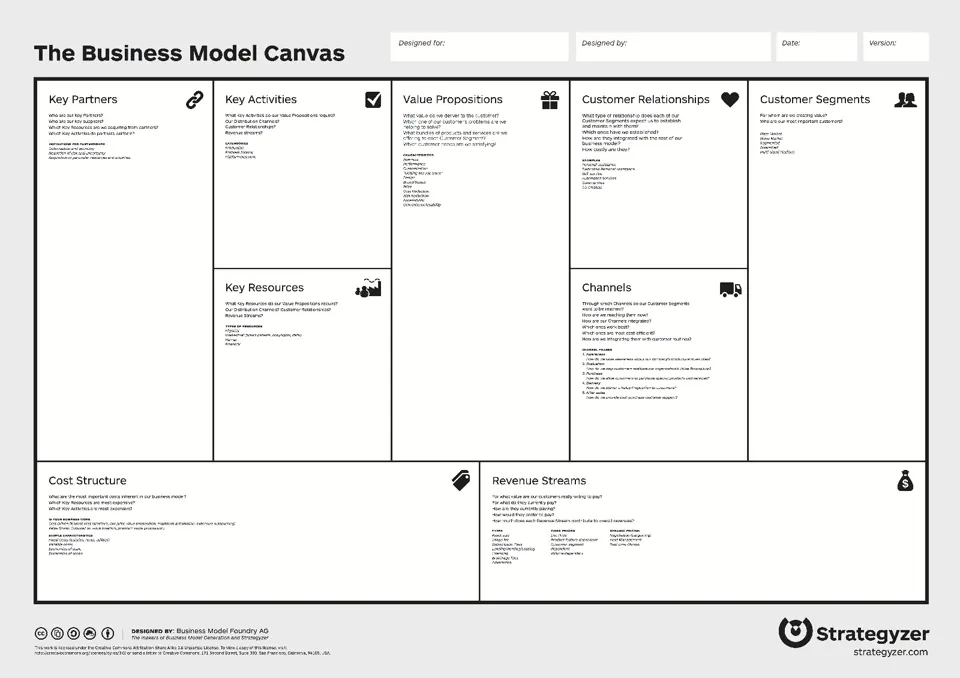
- Key Partnerships: Who are your partners (e.g., payment processors, map APIs for Uber).
- Key Activities: What the company does to operate and survive (e.g., acquisition marketing, platform development).
- Key Resources: What you use (e.g., money for paid traffic).
- Value Proposition: The problem you solve for the customer.
- Customer Relationships: How you relate (e.g., self-service, reviews, feedback, support).
- Channels: How you promote and distribute the product (e.g., website, app, WhatsApp).
- Customer Segments: Who you are solving the problem for. The more niche, the better, seeking the ICP (Ideal Customer Profile).
- Revenue Streams: Where the money comes from.
- Cost Structure: What the expenses are.
The Sandeco channel provides a link to download the BMC, encouraging iteration and recording of learnings.
Is Your Company a Startup or Traditional? The Checklist
To know if your business is a startup, Thiago presented a checklist:
- Scale Thesis: Can you grow 10x without multiplying the team and cost at the same rate?
- Repeatability: Do you deliver the same value in a standardized or automated way?
- Large Market: Is your market large enough for scale? It's crucial to calculate TAM, SAM, and SOM for investors.
- Growth Engine: Do you have a validated channel that allows organic acceleration? The Customer Acquisition Cost (CAC) must be less than the Lifetime Value (LTV).
- Experiment Pace: Do you test, measure, and iterate every week until reaching Product Market Fit?
If you meet three or more of these points, you can classify yourself as a startup.
One Person Business (OPB): The Trend of the AI Era
The Artificial Intelligence era has driven the One Person Business (OPB) trend, where a single person runs the entire business, facilitated by AI agents to automate tasks. However, Thiago warns that the complexity of a company still exists and there is a limit to what one person can do alone.
Google's Sprint Method: Fail Fast to Learn More
The Sprint method, developed at Google, is a 7-day methodology to test ideas. The philosophy is "fail fast" to learn and iterate.
- Day 1 (Map): Brainstorm all possible problems.
- Day 2 (Define): Choose a main problem to attack.
- Day 3 (Sketch): Sketch the solution to the defined problem.
- Day 4 (Execute): Build the solution.
- Day 5 (Prototype): Create a prototype (low or high fidelity).
- Day 6 (Test): The customer uses the MVP for validation.
- Day 7 (Learn): The team meets to analyze the results.
Types of MVP: Validating Your Idea in Different Ways
The MVP doesn't have a single form. Thiago presented several types:
- Smoke Test MVP: Create a facade of a product that doesn't exist yet (e.g., landing page) to measure interest.
- Video MVP: A video that demonstrates the value proposition before the product is functional (e.g., Dropbox).
- Concierge MVP: The entrepreneur manually performs the service that the product proposes to automate.
- Wizard of Oz: The user thinks the technology is working, but there's a person operating behind it.
- Piecemeal: Build the product by integrating third-party tools (e.g., WordPress, APIs, open source).
- Single Feature MVP: Focus on building and launching only the main feature that solves the most critical problem.
The MVP Experiment Canvas: A Guide for Precise Testing
To go beyond BMC and Sprint, Thiago presented the MVP Experiment Canvas, a tool to plan and document MVP experiments. It helps note hypotheses, success metrics, results, and next steps, allowing iteration based on concrete data.
The Secret Tool: Custom GPT for Entrepreneurs!
Thiago Peraro presented a powerful tool developed by him: a custom GPT that acts as a copilot for entrepreneurs. Trained with all the knowledge from the live session, it serves as an assistant to help you set up your MVP Experiment Canvas. Just paste your BMC and ask for guidance on your next iteration.
Conclusion
The Sandeco channel live session was a true mentorship, a "gold mine" of knowledge shared for free. From the definition of startup, through tools like BMC and Sprint, to MVP types and TRL, each topic was addressed with depth and practical examples. The cherry on top was the delivery of the custom GPT, a tool that consolidates all this learning and makes it accessible to any entrepreneur.
Follow Thiago Peraro on LinkedIn and Instagram for more insights. And don't forget to use the GPT and the Canvas models mentioned – they were created to boost your entrepreneurial journey!